Sunday, July 18, 2010

#8. C1: The Aliens

My roommate gave me Scott McCloud's Understanding Comics, which I read on the train ride to my audition for The Aliens. I read the chapter on icons, which suggests that the more simplified an image is, the more readily someone will identify with it.


I wondered, Isn't acting another form of cartooning? It's true that identification doesn't work the same with abstracted images on a page as when characters are portrayed by human beings before your eyes. Kenneth Branagh's Hamlet is not only unmistakably Hamlet, it's unmistakably Kenneth Branagh.

But the abstraction of human behavior does instill varying levels of sympathy. Characters are written and performed closer to or further from real people in accordance to the objectives of the artists. For the most part acting is the opposite of cartooning - realistic characters who speak and behave as actual human beings are more sympathetic than those who don't.

Of course, a character is only one part of the whole picture of theatre. Some characters are not performed with explicit realism - their lines don't overlap, their actions are calculated - so that an audience can focus on the arc of their actions as a whole. Even though they move like dolls and don't have nervous tics, a less complex character in an intelligently structured story can inspire the same sympathy as a realistic character. Mickey Rourke's Randy Robinson and Charlie Chaplin's Little Tramp are characters, but they're also devices for the story. Every character fulfills a different need. The key is context.

Along with the character descriptions for The Aliens, the producers also provided a note before the audition:

Playwright Annie Baker has asked that we look to cast "the least schmacty people you can find, the most painfully naturalistic guys out there... guys who are comfortable sitting very still and not "doing" too much.

The truth is that ever since I started acting I've been looking for a role in which I would be able to be so comfortable that I wouldn't have to put on any airs. I think I'm really good at it, as a matter of fact. This was starting to sound like it was right up my alley.

The problem with auditioning naturalistically is context. Audition monologues by nature are designed to show the biggest variations in energy and emotion in as little time as possible. They are the farthest thing from natural. So when I tried to take the edge off of Andrew's monologue, make it seem less calculated and more spontaneous, I just felt like a really boring guy talking about something really stupid.

I could've been perfect, but I had no material with which to prove it. I'm actually wondering what the hell the guys that finally do get cast will have auditioned with.

Maybe they sat still and didn't do much.



3 headshots remain.

Saturday, July 17, 2010

I'm a star! On the Internet!

WITH THESE HANDS: Episode 1 from Rough Week on Vimeo.


This has been a long time comin', a collaboration with all of my colleagues who are the best in their leagues at what they do, mostly being silly as hell.

Monday, June 28, 2010

#6 & #7. Shakespeare Now: Julius Caesar

Rough Week cohort Chelsea Schmidt was sitting at the check-in table at Boston Playwrights' Theatre. Indeed, she had volunteered for that position.

I reminisced upon the many auditions I've had at BPT. As a matter of fact, I auditioned for Shakespeare Now a year ago in this same place, not too long after I started this cockamamie blog.

It was then that I realized that I would be auditioning with my Romeo monologue, the same monologue I auditioned with back then.

Before I could consider how this reflected on my abilities as an artist, it was my turn. The two auditors were very nice, and asked me all about Emerson College and all the nice things they just got that I didn't get a chance to use before I graduated.

I had been alternately bored and excited by Romeo. He meanders in with some romantic imagery which is pretty typical of the most recognizable Shakespearean lover, and you're just kinda like, "Okay." But only later do you see it's REALLY all to illustrate to the Friar how fucked up his situation is.

That switch was so juicy to me that I suddenly felt my blood getting hot, and I raised my voice and focused my intentions and did all that acting shit.

It felt good, but all I might've done was illustrate the difference between my being bored and my trying my best. When, really, I should've been doing my best the whole time.

The woman who was waiting her turn when I came out was impressed with my voice, though - or at least what she heard from the lobby.


4 headshots remain.

P.S. I also met the Boston Playwrights' dog once again. I can't tell if he liked me or not. We met once before, I think during SLAMBoston, but I forget his name. How embarrassing!

Wednesday, June 16, 2010

#5.5 ASP Callback

Actors' Shakespeare Project called me back for the ensemble in Henry IV. I had missed their audition nearly a month ago because I thought it was in a location other than it actually was. They must have called me back because of my StageSource audition, which didn't make sense to me - I had not performed a classical monologue, and had gone over the time limit. I love Shakespeare, but I hadn't given any indication that I'd been formally trained to perform it. Why was it they wanted to call me back?

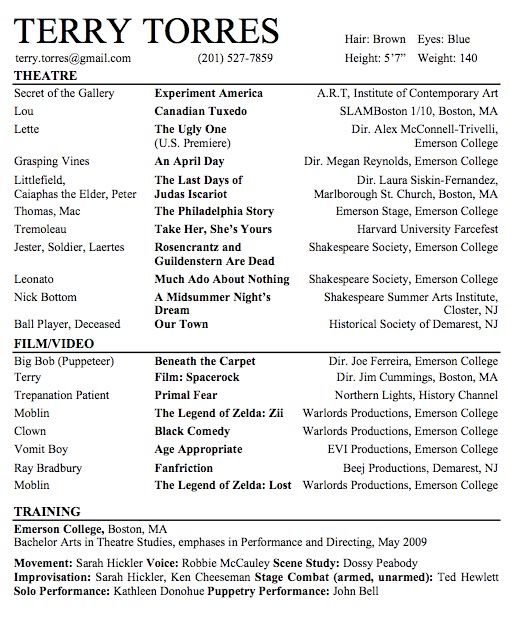
Hey, you know what we've never taken a look at? My resume.


My resume always feels like an afterthought in the audition process, but when directors and such only get to see you for 2 minutes it must be invaluable for filling in the blanks when your face and your chosen material aren't enough to paint the whole picture of you as an artist.


Still, what in particular made me worth exploring? Was it the only three Shakespearean credits I had? True, The Shakespeare Society was the only group producing any of Bill's work at Emerson College, but they had no way of knowing that, did they? Just as they had no way of knowing that the Shakespeare Summer Arts Institute was run out of a house in suburban North Jersey.

It could be that they trusted my Emerson education. I know that many alumni and professors alike have been involved in ASP productions. And if casting can be decided by pedigree and specialized knowledge, then I was pretty sure which shard of information would've been most intriguing.


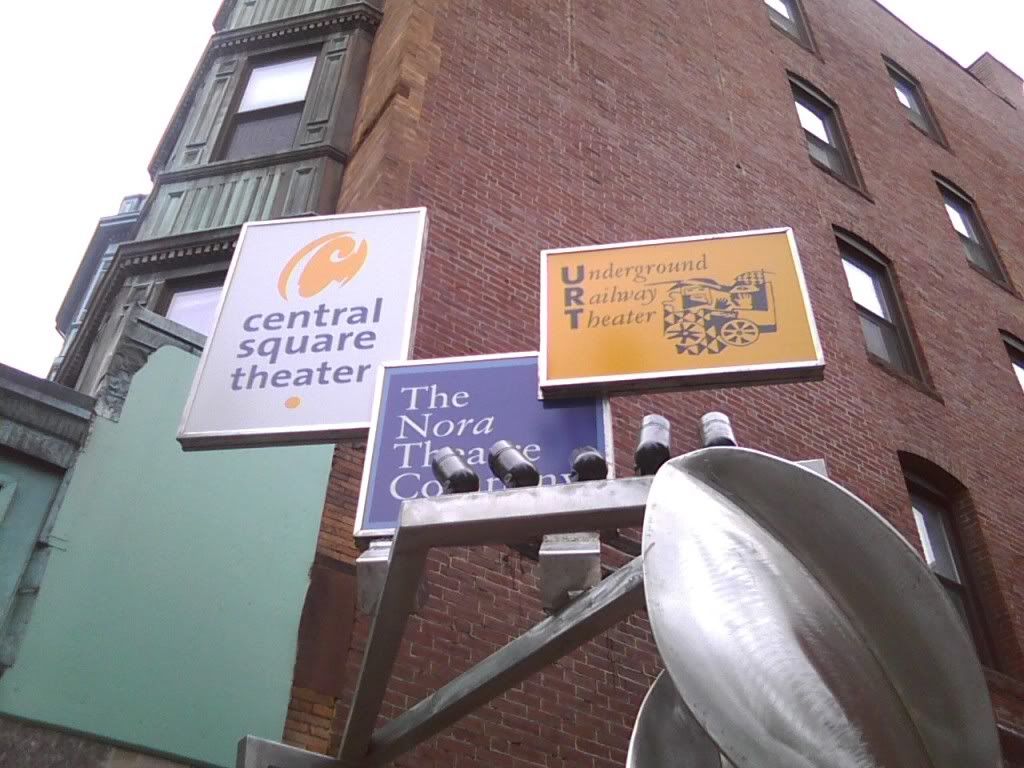
Callbacks were at Central Square Theater. It's a real nice place, but I'm embarrassed to say that I've only ever seen one production there - a show based on the dreams of a pregnant woman, which had its moments. I'm blanking on the name.


When it was my turn, I was greeted in the theater by Allyn, who introduced me to Patrick the director. I dusted off Romeo, which I hadn't used for an audition in a very long time. And then, in accordance with the email requesting "a short ditty" to go with my monologue, I sang Brazil. My voice felt hollow when it came out, but I kept a smile on my face to spite my vibrato.

Allyn asked me about my stage combat experience. I KNEW IT, I thought, and told him all about Ted Hewlett, rapiers, broadswords and quarter-staffs.

My legs were aching when I left. Had my knees been shaking? I didn't realize how nervous I was! I wanted to work with these guys more than I thought.

This was the first callback to come from my StageSource audition. Will it be the last? Beats me!


5 headshots still remain.

Tuesday, June 8, 2010

#X. StageSource


A number of producers from many companies in the Boston area attend StageSource's auditions. A few actors are contacted for roles immediately, some are considered much later down the line. Many others are cast aside. For a young actor in Boston, it's the biggest opportunity of the year to appear in a stage production. I had registered for my position in the auditions months before.

Only the night before - while taping resumes to the back of the 50 headshots I would be submitting to StageSource, and also while getting ready for the Rough Week fundraiser which would also be the next day - I decided to look up specifics on what the audition required.

They requested two contrasting pieces. I figured that much. What I didn't quite realize was that each actor only got two minutes to audition.

Two pieces in two minutes. An average of a minute per piece.

This was mind-boggling to me. It's hard enough to find two monologues that are 1) good, 2) appropriate for your type and 3) representative of your acting range in combination with other monologues, but they had to be under a minute as well? That's no time at all to get into and out of a character!

I'm not saying it's impossible, but it's certainly God damn bothersome, especially for someone like me who doesn't like to be rushed. I simply didn't have any monologues that short, and cutting my longer material was out of the question - I had already cut them all with great exactitude and taste. Starting a sentence late or ending a sentence early would disrupt the emotional rhythm.

What I finally decided to do on the train ride over was to simply remove any and all pauses or instances of hesitation and internalize every new objective as I arrived at it. Basically, I talked real fast. It was quite an exercise in itself. I had to be deft and deliberate in my delivery.

I timed myself by my watch. Each monologue (I chose Red Light Winter and Candy Factory) ran about 2 minutes at the start, but I was able to get them down to about 1 minutes and 15 seconds each at their best. I'd be sure to take advantage of whatever leeway the stage manager would give me.

Only once I sat down in the hallway outside of Boston Playwrights' Theatre listening to the other actors audition through the wall did I accept that fact: I was going to be timed out.

And I was, four sentences before the end of my Candy Factory monologue. I smiled, said Thank You and returned the chair I was sitting in to upstage right before taking my leave.

I had brought 50 headshots, and only 45 were requested. 5 more were returned to me, either by producers who already had my headshot or didn't want it.


5 headshots remain.


10 headshots in reserve.

Sunday, May 30, 2010

#5. Boston Actors Theater Summer Play Festival

"Do you ever feel that people are like mannequins?" Glenn asked me. I wouldn't know his name was Glenn until he introduced himself to me two minutes later.

I smiled at him the same way I smile at someone who is complaining about a bus that's behind schedule.

Glenn was walking on the sidewalk in the direction I was coming from when an older, smaller woman mechanically stepped out of his way and resumed walking without acknowledging him as a living person with a destination at the end of his path.

"I did some paintings once," he said. "I painted people, portraits, and I combined them with mannequins. They weren't quite people, but they weren't quite mannequins. I thought that was interesting."

"Huh," I said.

"Does that make sense?" he asked me.

I could have concluded the conversation by telling him that I had someplace to be, which was true, but I didn't have to be there for a while yet. We had both come to a stop outside of Bruegger's Bagels on Harvard Street, which seemed to signify some kind of understanding between the two of us.

Actually, it would be a tenuous assertion to suggest that I understood anything about Glenn or my relationship to him. He could have stopped anyone on the street to talk to them about mannequins. As far as I know he had already done so six times since waking up.

But I couldn't discount the possibility that only at this moment did he summon up the gall to speak his mind about the inability of people in modern society to connect with each other and, by extension, their own selves. I felt it was my responsibility to meet him halfway.

We talked about how social mores, educational institutions and technology kept people from observing their environment or respecting each other. I told him about the transforming campus at Emerson College, that a certain percentage of pre-adolescent girls consider Facebook to be an integral factor in their life. I told him that, as an artist, I'd come to think many of the same thoughts that he had. For some reason I introduced myself as a writer rather than an actor, which surprised me after I had done it - it wasn't a lie, but it felt like one. I must have thought that there were too many stigmas attached.

Isolation and the impossibility of open communication haunted me throughout my school days. I'm mostly through with entertaining such ideas on a continuous basis, but Glenn, a gentleman some years my elder, spoke as though they would decide his actions for the rest of the day at the very least. I knew; Glenn was at a particular point in his life. I might have continued walking past him and left him with his thoughts if I hadn't fallen asleep wearing my contacts the night before, leaving my eyes scratched and watery and my vision slightly impaired. My defenses were down. Glenn and I both were being detached from our realities.

Still, I know the dangers of growing comfortable in discontent, having your dark thoughts validated. I looked at my watch and said "Oh!" and that I had an audition to get to. He bid me Good Luck, and thanked me for taking the time. I told him to take care.


I read one side for all the directors. I don't think they liked the look of my red, scratchy eyes, so that was all I read.


5 headshots remain.

Monday, May 24, 2010

Re: Zeitgeist Stage

Terry -

Recently ran across your blog entry about auditioning for FARRAGUT NORTH, and how you were surprised you weren't given a second side to read.

In the Information Sheet (yellow) you were handed to read, along with the audition form to complete, it states that due to the large volume of people auditioning everyone will receive only one reading. You were encouraged to "Make choices and take chances." We had over 130 people signed up to audition, which does not allow us time to offer multiple readings to those auditioning.

Sorry, you were disappointed that you didn't get a second reading, but we are up-front about that during the audition process.

Thanks
David Miller
Zeitgeist Stage Company


David,

Thanks a lot for reading. And thank you even more for your clarification.

What I personally like about my Farragut North post (it's not fantastic, but, well) is that it leads with the initial excitement over the material, but ends without even a reflection. I didn't mean to suggest that I was upset or that it wasn't at all worth my time. I just thought it would read funnier with that kind of brevity.

Though I hope to try and use my blog as a young professional's guide to the audition process, my 10 Headshots posts come very much from the gut. It's difficult for me to separate my working actor's mind from my writer's mind, as difficult as it is to recognize the results of my audition as being a reflection of my skill against expectations, or of my own karma against fortune. In these situations it's very easy to write from a "me vs. everyone else" perspective, and cynicism as a writing quality comes very naturally to me. I find that both children and actors have a hyper-developed sense of unfairness, and that theme tends to runs throughout the blog. It's fun, but I'm certain that it's not always helpful as a persisting mindset, to me or to any readers.

I did see Farragut North a few days ago, along with Andres' sister. I thought it was pretty terrific. And I'm not just saying that.

Keep reading, and I hope I see you around.

Terry


While I realize it is agonizing for actors putting themselves out there for the audition process, the producers are under an obligation - in my mind - to give everyone an equal opportunity and to be respectful of the actor's time. Since we had so many people come out for our last several auditions, we developed the 'one reading' rule as a way to try and do both. Communicating that to the actors beforehand is also important, I feel.

Anyway, I'm glad you enjoyed Farragut North. Keep coming out, you never know when you'll be the right one for a role.

David