Wednesday, October 17, 2012

The Starving Actor: Beans and Rice

You're home between shifts, and you've got JUST enough time for lunch. You want some protein and some carbs and you just wanna eat all of it

But all you've got is rice and a can of beans.

That's alright. With a little effort, we can make this meal a little less depressing.


Beans and Rice

A tablespoon of oil (and some more on standby)
About 2 cups of rice
A small onion
A medium clove of garlic (or garlic powder)
1 15.5 oz. can of beans (black or kidney)
Salt
Pepper
Oregano
Cumin
Paprika


[Unlike carbonara, this recipe is very free form. There's a wider margin of error, and more leeway when it comes to things like seasoning and consistency.]

1
First off, cook some rice. Put a little less than two cups of rice in your rice cooker, and cook to your preferred level of dryness/stickiness.

If you don't have a rice cooker, then, Jesus, I'm sorry. Get one. This one was $20 at a local hardware and kitchenry store. They're so convenient for poor artists.

If you don't have a rice cooker, cook rice the way that you normally cook rice: take a little pot, some some rice in, put in double the amount of water, cook it on medium-low with the lid on, and don't take that lid off.

ANYWAY, while the rice is doing its thing,


2
Finely chop a small onion and mince a medium-sized clove of garlic. Or a large-sized clove of garlic. If you love it, then just HAVE it.

Now, we're going to start by cooking the onion and garlic in a fat of your choice. The healthy choice would be olive/vegetable/canola oil. Doing so would keep this meal completely vegan.

I went with bacon grease. Since we have so much.


3
Over medium heat, put about a tablespoon of oil/grease into a small pot (or saucepan as fancy recipe magazines tend to call them - they look like pots to me).


What I like to do to move things along is tilt the pot slightly so the fat makes a little pool. If you shake and angle the pot, you can use that little pool to coat the whole cooking surface.


4
Now throw that damn onion and garlic in there. Give them a stir (Use the fork you plan on eating it with to save time later during clean-up!) to make sure that they're evenly coated with your oil/grease.


If it seems a little dry in there and some of your onion is lacking shine, feel free to add a little more fat, like I did. You don't want to sautee these guys so much as you wanna soften them. This is gonna be the foundation on which we build our beans.


5
So we're gonna zap 'em with a little flavor. Add about three shakes each salt, pepper, oregano, and cumin. You can do a little more or a little less of each depending on your preferences.

I just realized that the paprika is kinda creeping behind oregano there. What are you doing? Get outta there. We don't need you.


6
Give it a stir and cover until onion is softer and just turning translucent. Drop the heat slightly to avoid browning the onion. Interestingly, this lid does not belong to this pot, but it works!


Meanwhile: the rice cooker is cooking the rice. I don't even HAVE to pay attention to this thing. When it's done, I'll have cooked rice. How great is this


7

Get your beans ready. Black beans or red kidney beans work best. And always Goya. Goya will never let you down. I fucking swear by Goya.


Once the onion is mostly cooked through - that is, soft and definitely no longer raw - pour in those beans, liquid and all. Give it a stir and crank the heat. Get it to a simmer.


Check it out! I found the queen bean! Incidentally, I guess you shouldn't buy Goya if you're vegan.


8
Time to season again! Hit your beans with salt and pepper.

Then stir again, cover, and keep the heat on so the beans continue to simmer.

In my travels, I've learned the advantages to cooking something in a pot or pan with or without a lid.

With a lid
Liquid is conserved, keeping contents wetter and soupier.
Heat is conserved, making the boiling point much easier to reach.
All the ingredients within soften and share flavors, like a swingers party.

Without a lid
Liquid is reduced, making contents less watery and more viscous.
Heat is reduced, allowing cooking without fear of liquid boiling over.

When it comes to cooking something like beans, combining covered and uncovered cooking is the way you achieve the results you need.


9
While the beans are having a flavor party, let's fluff rice! Fluffing the rice and mixing it up makes it happy, and makes it so that it doesn't just form into a mold of the pot it's been cooking in.


10
Uncover the beans and take a few out for taste testing. They should be soft and, most importantly, taste good. Mine didn't right away, and I was a little concerned at the paleness of the whole affair.


Last time I did this, it was with black beans, and the liquid black beans come in are closer to the color of the beans themselves. Kidney bean liquid is paler, which can be a little off-putting.

11
So, I put a little paprika in there, which I was so ready to shun earlier.

At this point it's a waiting game. The longer the beans cook, the softer they will get, and the smoother the concoction on the whole will seem.


At 10 more minutes, my beans were looking a lot healthier, as the paprika did its thing and the excess liquid began to disappear. Give it another taste test before you commit to declaring the meal a success.


Once it's to your liking, put your beans over some rice and enjoy a simple-ass meal with plenty of rice and protein. I had OJ with mine, and it worked for me.

You can also fill that bean can with change and then shake it to stop dogs from barking.


Yeah, you stupid idiot, you have no idea what you're in for.

Hey, wait a minute.


There's already a recipe for rice and beans on the back of the can!

Wednesday, October 10, 2012

#4. Fresh Ink's Second Season

I worked for Fresh Ink before as a stage manager. But now, I sought to be a stage man; eager.

There were auditions for two shows. When I expressed interest, I received sides for both plays.

THE EMBRYOS, about a family that tries to raise their failed embryos as children, sounded like a hoot, but I knew the only role left for me us the male embryo, and something in my head told me, "No... that's not for me."

But FIRE ON EARTH, about the smuggling of illegal translations of the bible during the reformation of the church of England, not only sounded great, but had a part that made perfect sense to me.

John Frith, a real life opponent to the Anglican Church, was earnest, gentle, and ready to die for his beliefs.

I was asked for conflicts for both shows. I wrote down my conflicts for The Embryos before I realized I didn't really want to audition for it.

For my last handful of auditions, I was just happy with the prospect of being considered for any role. It's empowering to finally have the opportunity to say, "No - I want THAT role."

I read specifically for Frith at The Factory Theatre before, I believe, most of the Fresh Ink staff and the director of either show.

I got to go all the way through both sides, and it felt good.

I'm excited for the show, whether or not I'm in it.


6 headshots remain.

Wednesday, September 19, 2012

#3. The Book of Mormon

I took a night off from checking my email after coming back from Brown Box's Romeo & Juliet tour. Being in Maryland with only a dumb phone, I had already taken over a week off from that particular responsibility and figured another 14 hours wouldn't hurt.

Lying amongst the ticket offers for ethnic dance troupes and online-only CVS gift cards, there was an email with the subject header The Book of Mormon, sent from a Gmail account, asking me to audition for the Broadway, Chicago, and national tour productions of the Tony-winning musical.

"Pfft, yeah, sure," I thought, "A casting company using a Gmail account? How droll."

For the hell of it, I said I was available the very next day. Twenty minutes later, I received a reply with every detail about the audition, and a link to a Dropbox folder with audio, sheet music, and sides. I was asked to prepare Man Up and scenes #3 and #4.


I couldn't goddamn believe this was happening again.

When I was first offered, unsolicited, an audition for a musical, I said it was the most unexpected thing that happened to me as an actor.

I definitely did not expect it to happen twice. And I did not expect the second time to be for the national tour of fucking The Book of Mormon.

When I was asked in for Bat Boy, I chalked it up to a clerical error. This time, though, the casting director specifically mentioned my New England Actor profile as the reason he wanted to see me.

I figured they just wanted some bug-eyed white dude to play a Mormon at the beginning, since there is no mention of musical theatre training on my profile, nor are there musical credits.

Even still, I was asked to read for one of the leading roles, Elder Arnold Cunningham.

I knew nothing about Book of Mormon except for Matt Stone and Trey Parker's involvement, so I went to Wikipedia and YouTube to read the story and learn the production history and hear the songs.

Every once in a while, a side of my brain would say, "These notes are too high to actually be physically sung, let alone well," with the other side of my brain saying, "Yeah, I know."

There was something almost like confidence beneath all of my anxieties. The odds of my being cast were infinitesimal, even moreso than the average audition. Whatever the percentage there was to begin with, another couple of zeroes was slipped in before that number when you factored in my complete lack of training, lack of familiarity with the show, lack of time to prepare, and the sheer amount of competition for a national tour.

But I said Yes to the audition already. Whatever that number was, I could either sink into despair and multiply it by zero, or I could do as well as I could given my time and resources and multiply it by 1.0000000000001.

I loaded Man Up and its accompaniment onto my iPod and strolled out into the night. I wasn't a musical theatre performer, but I'd treat this audition like I treated the others. I just needed some alone time.

But it's hard to be alone in a city when you have to find out whether or not you could hit the high notes. I actually marked the music where I thought I should drop the octave. Amazingly, I found out that I didn't HAVE to drop the octave, and that I COULD - very briefly - hit that high G. All of the dudes laughing outside of the auto repair place I walked by found out, too.

After I got through the song without dropping the octave, my diaphragm felt strained, so I called it quits for the night. Doing a lot of reading about voice over, I've been more sensitive to the support of my breath and the health of my vocal cords, and I didn't wanna hurt nothing.


The next day, I had a tour that ended with just enough time for me to get to the audition at the Jeannette Neill Dance Studio. I had no time to sing it for anyone, or to hit these high notes again before the audition.

I left work in such a hurry that I forgot my slick-yet-charming Ralph Lauren shirt. All I had was my undershirt: the T-shirt that I got when I graduated from Emerson College, with Emerson College's logo upon the breast.

So now I was gonna be the douchebag hearing his alma mater. With a little teriyaki stain on the collar. But then I thought, Hey, maybe the casting director is an Emerson alumnus!

When I got to the studio lobby, it was so quiet I could hear my heart beat. Maybe it's just my prejudice, but I imagined the room outside of a musical theatre audition to be much livelier. Five other people, slickly dressed and examining their music, sat, not saying anything. Through some persistent corner-out-of-eye-looking, I saw that nobody else had the same music as me. It seemed like no one else was called in for the same part that I was.

When I had to sign in, there was a little box under the words ROLE DESIRED. I was called in for Elder Cunningham, but I would never imagine actually being cast in that role. Someone else had written "Elder McKinley", one of the other Mormons. I wrote that down, too.

For the next 20 minutes, I sat, leafed through my music and my sides, and watched people come and go. A sharp, handsome gentleman was running the floor, calling names, saying Hello, taking headshots. I wondered how many people would be in the audition room.

As I waited, I could hear some of the other auditions, and I got nervous again, sometimes reminding myself to Just keep breathing, it's the one thing you'll always have control of.

Finally, the man came out for me and I handed him my headshot. I saw someone else take their tea in with them, so I took my water bottle filled with licorice root tea along. I dropped it just outside of the audition room, bent down, and picked it up again.

The only other person in the room was behind the piano - so this guy I was seeing this whole time WAS the casting director. As he closed the door behind me, he introduced me to the accompanist.

I walked over to shake his hand, uninvited. No, fool, what are you doing! Don't shake anyone's hand in the audition room unless they offer first! This is an AMATEUR'S MISTAKE!

The director suggested that we start off with the song, Man Up. Seeing my face and my name, this guy seemed to know who I was and knew what he wanted to see me for, unlike the director in my Bat Boy audition. Heartened, I began enthusiastically.

And inexplicably started a full octave higher than was written, cracking in the process. "Sorry, I had a... tour today," I said, apparently assuming all of the subtext of that sentence would be immediately understood.

When I resumed again, I gesticulated wildly, which I believed was signalling that I understood the irony of the material and the sincerity of the character. Halfway through, I had no idea if that was the right thing to do. I realized that I didn't know if they wanted me to sing so they could know that I could sing, or if they assumed I could and they just wanted to see if I could act, or if I shouldn't act so that I could just focus on singing real good. Nobody taught me this.

I was amazed they let me sing all 47 bars without stopping me. When the director suggested we go to side #3, I jumped at it.

In my mind, what was so funny about the sides is how much they reminded me of South Park's writing. It was mostly my character being naive and childishly overjoyed about the future.

I showed over-the-top, unfocused excitement, jumping and punching the air, swaying my weight from foot to foot. I was playing a caricature as opposed to a character. The director let me do it again, but before he did, he told me to plant myself, because my moving around was distracting.

I never truly trusted myself. Every mistake I made was amateurish, lessons that I thought I had learned from every single other audition I had written about.

But somehow, because I counted myself so out of my element, because I felt so guilty trying for something I didn't think I deserved, I forgot even the most basic tenets of auditioning.

Before I left, though, someone else who had come in asked me where the bathroom was. I told him to go down the hallway and take a right.

If nothing else, I was able to give a least one person something they wanted to hear.


7 headshots remain.


Bonus: When I looked up Elder Cunningham, I found this guy. Your problems are over.

Saturday, September 1, 2012

VOTE FOR ME ON HERO CAST

PREVIOUSLY ON X-MEN 10 HEADSHOTS

Jesus, that was a long time ago. Sorry, guys, I been too busy making that sweet summer scrongi. And being serious about video games.

I auditioned in Framingham for a part in a quinology of films about super heroes in Boston.

American Idol-style, my recorded audition be put online and all of those fans of the Mission Park Quinology could vote for their favorite super hero hopefuls.

Well, mine is finally up!


Also featuring Curtis Reid as my scene partner. Nice going Curtis!

Now, I don't think I'm a bully or diva, so I wouldn't assume that you'd

VOTE FOR ME

just because I'd ask you to. But if you think I've earned it, having watched my audition, then you can go ahead and

VOTE FOR ME.

Or hell! Vote for anyONE of the hopefuls on the ballot! The choice is yours!

DECIDE THE FATE OF THE MISSION PARK QUINOLOGY!!

EDIT (9/19/12): I didn't make it to the next round. Oh, well!

Wednesday, June 27, 2012

#2.5 Mission Park Quinology

So a banner on New England Actor was advertising auditions for a series of super hero films. Why WOULDN'T I click it?

What was a little confusing about the auditions is that I had to sign a talent release prior to my arrival. Evidently, the production company planned on making a web series about the audition process for the films.

But wait, which production company? Who had plans to production five films at once, with reportedly 160 roles to fill? Only after I signed up to audition did I decide to do any research.

My talent release credits F.R. Perro, Inc. with production.

The Mission Park movie website links to Perro Worldwide Comics.

All of the movies are based on a comics created by Chip Perro.

Seems like there's a little world living between the lines here, and I don't just mean the alternate universe of Boston-based super heroes.

The PWC site looks a lot like some of my old ZIP disks: museum for a bunch of good ideas that haven't quite come to fruition yet. Rough drawings, a spin-off for a series that hasn't been made readily available to the public. Unlike my Final Fantasy VII fanfiction, though, Mission Park is on its way to achieving something greater.

What threw me off, besides everything else, was that a film with these characters was already made, even though auditions are currently being held to fill those roles. I guess that film was something like a prototype, a pilot. Or they're casting a reboot. You know how super hero movies can be.

Actually, what REALLY threw me off was that the audition would be in Framingham. So I borrowed my roomies' faithful Jetta to make my way to Molly Malone's Irish Tavern at the Framingham Sheraton Hotel.


To one side of Molly's dining area was a reception lounge, complete with armchairs and a fireplace. To one side of the lounge, on the other end of the camera, set up with two chairs, was the audition space. It looked like we'd all be auditioning in front of each other.


Auditions were done in pairs. Basically, every two people who arrived at the front table were made a pair and would read the sides together. I was not as timely as I could have been, and was in the last pair.

I watched every audition. It was quite a diverse crowd, especially in terms of experience. People seemed friendly, but since the camera was rolling there wasn't a whole lot of carousing, so most just watched and grabbed some cheese and crackers from the side table. Yeah, snacks! THAT'S how you hold auditions!


Finally, I read with Curtis. He was cool! We read two sides, switched roles for each, for a total of four reads.

I wasn't sure I showed enough dimensions between all of my reads. The sides were actually pretty cool. A more realistic super hero story, something between Mystery Men and Watchmen.

Afterward, I found out from the producer that the our auditions would be put online. AND THEN, the half that received the most votes online would go on to the next level of auditions. Yeah, it turns out their doing this tourney style.

The voting would only be for leads. Having auditioned, I could be considered for any of the 160 roles across the five films.

If I win, I get a chance at being in five films.

If I don't, I don't have to drive out to Framingham again to audition.

Saturday, June 23, 2012

#2. Whistler in the Dark Season Auditions

Heard of Whistler? You should've! I've written about them once before. And lemme tell you, they're great.

Auditions were for "a play" by Caryl Churchill and "a play" by Timerlake Wertenbaker, and that any actor's audition materials should be in the style of one of these plays. Even though the plays haven't been decided yet!

That was a little frustrating. However, I do appreciate the level of effort being request on the part of the actors. No use falling back on some old monologue, they seem to dare!

So I worked on an all-new monologue from Shaw's Candida. I figured, "Hey, these playwrights are British, sometimes write period pieces, and deal with feminist ideas!" Or in Shaw's case, anti-feminist, but still very penetrating looks into the relationships between men and women and how men-ness and woman-ness can get in the way of that.

The audition place was Charlestown Working Theater, which I'm pretty familiar with now having seen and assisted on a couple of Theatre on Fire. Nate Gundy, a Whistler regular and fellow Freedom Trail player, pointed me upstairs. The actor pen was right next to the audition room, so even though many people wanted to talk, they could not. I said Hi to some familiar faces, including Dakota Shepard and Caroline Price who were in Fresh Ink's phenomenal production of Priscilla Dreams the Answer. Phenomenal because I stage managed it.

When I stepped into the audition room, the directors of the two productions, Meg Taintor - who is also a prolific promotional photographer for many fringe productions - and Mac Young - who I was in Imaginary Beast's Dracula with - both gave me a hug. And then I did my monologue.

AND THEN, Jennifer O'Connor, Whistler co-founder and another Freedom Trail player, stood up and acted as my scene partner when Mac asked me to do the first half of my monologue again, with more of an emphasis on driving my point home and "winning" the argument. So I went again. And it felt so much more natural, especially with someone who - Jennifer was good at this - would let their attention drift if I was not catching it, forcing me to push even harder.

I was disappointed in myself a little for not achieving that level of realism on my first go. Nate Gundy assured me on my way at that at least I could take direction. Thanks for saying those words, Nate Gundy.

Looking back, I realized this is how my first audition with Whistler went as well. I LOVE this practice of doing the monologue again with a new direction and someone to talk to, like you would be doing if you were cast in a goddamn play. It's a brilliant way to deal with the monologue problem -  That is, the problem of everyone hating doing monologues - just make them dialogues! Even if the other person doesn't talk.

This is one of the most pleasurable experiences I've had at an audition. And maybe it's partly because I knew so many people involved. Maybe that means: I'm doin' it?


8 headshots remain.

Tuesday, June 19, 2012

Monologue: Candida by George Bernard Shaw

So this is how I work on a monologue.


With a new monologue, I get it down on paper.

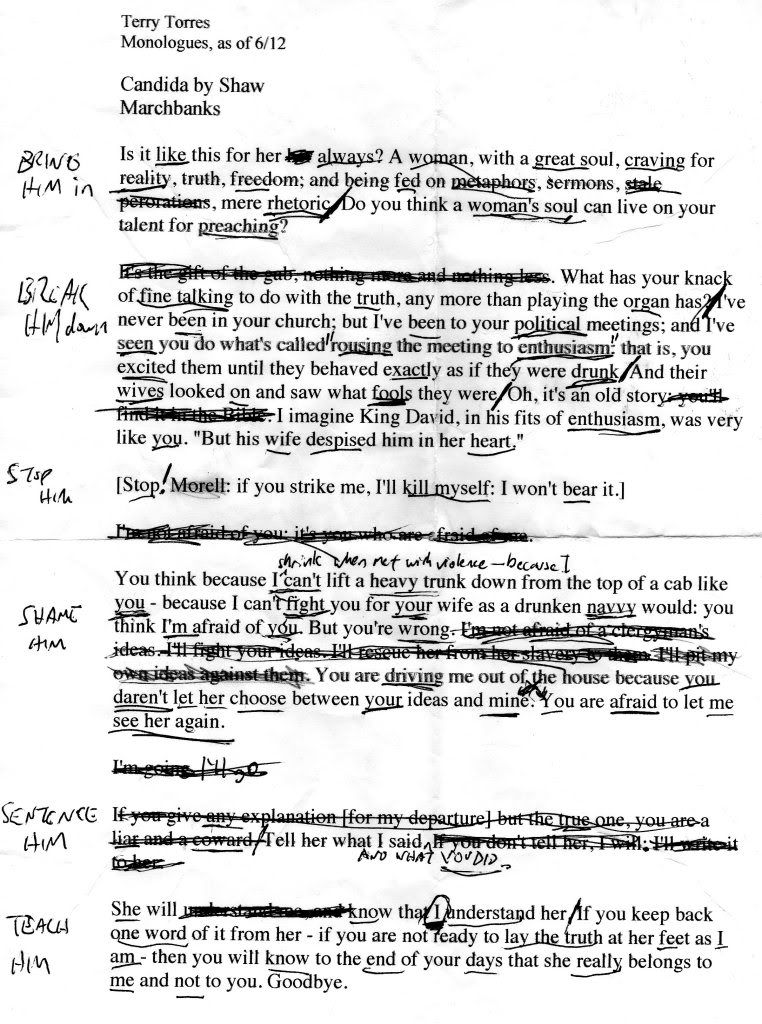
I used to write out monologues by hand, but I typed this one because I had to do some serious editing with it.

This one's from George Bernard Shaw's Candida. It's not commonly known from my understanding, but it was part of a Shaw collection I'd bought a long time ago. I happen to like it quite a bit. The character of Marchbanks here is professing his love to the wife of a preacher and political leader, telling him that he is unfit of his wife's love.

HOWEVER! Most of this monologue is actually from quite a bit of dialogue between Marchbanks and the preacher. Most of the line breaks represent dialogue that was cut. Thanks to Shaw's writing, Marchbanks' point still makes sense with the cuts.

There are a lot more words crossed out. That's mostly for the sake of timing - this should run at about 2 minutes. I cut anything that didn't support that main point of the monologue.

And then, y'know, I underlined some lines. This is mostly placebo-esque voodoo nonsense, but I pick the words in a sentence that are most important. It might seem really obvious, but going through the monologue underlining words that strike you as you speak them aloud, I think, is just another way to bring you and the text closer together. And really, that's what this is all about.

/'s help me indicate beats shifts, where my objective changes.

The big shift in this monologue is right in the middle: "Stop! Morell: if you strike me, I'll kill myself: I won't bear it."

This is a direct reaction to something that the person being spoken to does physically to the speaker - something that doesn't actually happen. It's a tough sell, but the beauty of this monologue is what changes in Marchbanks before and after this altercation - how self-assured he starts, and how incensed he becomes. I've never done anything like this before in a monologue, but I think it works.

I'm also told this, being written by Shaw, is what we would call a modern monologue, as opposed to a classical or contemporary monologue. From the way I understand it,

Classical: Like Shakespeare and those guys.
Contemporary: You could talk to the child of this writer, or the person if they are still alive.
Modern: Whatever isn't the first two (The writer has been dead for a while, but not like SUPER long).

Once it's all written, I just go through it, taking each phrase off the page. That is, whenever I say the words aloud, I never look at the words on the page - I always looks elsewhere. Otherwise, the words will just stay on the page. If you take them OFF the page, they'll float into the air and then into your brain. Seriously, try it.

Once I've got it memorized (and this is the hard part), I go through the monologue and as I speak each word I perform a gesture to go along with it. Like, everyone word, even "the". You don't have to think TOO hard about each gesture, you just have to make sure that each one is different from the last. For a two minute monologue, it might take 10 minutes or so. But it's worth it. I'm told this is one of those Meisner techniques? Whoever THAT guy is! Anyway, it helps me figure out how I REALLY feel about the text.

After that, I go through again, instead I perform it with my arms at my side, looking straight ahead, super-minimalist. Kinda like a "cool-down" from the previous exercise. It also helps me figure out which times I'm driven to move my body, when I'm real excited and I just wanna DO something.

After that, I do whatever. Might go through at half volume as I walk about town. I might do it again in a public place, like a hill in Boston Common, where people will think it's funny.

And hey, dudes: do your monologue for at least one other human being before your audition. You may not be crazy into the idea, but it almost always gives you useful insight. Well, as long as you know insightful people. Anyway, you won't truly know how a monologue works in front of people until you do it in front of people.

EDIT (6/21):

Something I just realized is that all of this editing of an existing work, you might think, "Well, why not just write your own monologue?"

The thing about writing your own monologue is don't write your own monologue. Editing is one thing, because you can still say of this monologue, "It is from George Bernard Shaw's Candida."

However, if you were to introduce your monologue in an audition by saying, "This is a monologue I wrote," you're conveying that you could not find an existing monologue that you could make work, so you wrote one for yourself.

Acting is interpretation. In an audition, a director is asking of you, "How well can you interpret text, and how well will you be able to interpret my direction?" By doing a monologue you have written, you're saying, "Nope, I can't do any of that shit! I'll just audition with this thing I already know all of the subtext for because I wrote it."

So, yeah. I don't think that's actually a thing too often, but don't do it.