Wednesday, June 27, 2012

#2.5 Mission Park Quinology

So a banner on New England Actor was advertising auditions for a series of super hero films. Why WOULDN'T I click it?

What was a little confusing about the auditions is that I had to sign a talent release prior to my arrival. Evidently, the production company planned on making a web series about the audition process for the films.

But wait, which production company? Who had plans to production five films at once, with reportedly 160 roles to fill? Only after I signed up to audition did I decide to do any research.

My talent release credits F.R. Perro, Inc. with production.

The Mission Park movie website links to Perro Worldwide Comics.

All of the movies are based on a comics created by Chip Perro.

Seems like there's a little world living between the lines here, and I don't just mean the alternate universe of Boston-based super heroes.

The PWC site looks a lot like some of my old ZIP disks: museum for a bunch of good ideas that haven't quite come to fruition yet. Rough drawings, a spin-off for a series that hasn't been made readily available to the public. Unlike my Final Fantasy VII fanfiction, though, Mission Park is on its way to achieving something greater.

What threw me off, besides everything else, was that a film with these characters was already made, even though auditions are currently being held to fill those roles. I guess that film was something like a prototype, a pilot. Or they're casting a reboot. You know how super hero movies can be.

Actually, what REALLY threw me off was that the audition would be in Framingham. So I borrowed my roomies' faithful Jetta to make my way to Molly Malone's Irish Tavern at the Framingham Sheraton Hotel.


To one side of Molly's dining area was a reception lounge, complete with armchairs and a fireplace. To one side of the lounge, on the other end of the camera, set up with two chairs, was the audition space. It looked like we'd all be auditioning in front of each other.


Auditions were done in pairs. Basically, every two people who arrived at the front table were made a pair and would read the sides together. I was not as timely as I could have been, and was in the last pair.

I watched every audition. It was quite a diverse crowd, especially in terms of experience. People seemed friendly, but since the camera was rolling there wasn't a whole lot of carousing, so most just watched and grabbed some cheese and crackers from the side table. Yeah, snacks! THAT'S how you hold auditions!


Finally, I read with Curtis. He was cool! We read two sides, switched roles for each, for a total of four reads.

I wasn't sure I showed enough dimensions between all of my reads. The sides were actually pretty cool. A more realistic super hero story, something between Mystery Men and Watchmen.

Afterward, I found out from the producer that the our auditions would be put online. AND THEN, the half that received the most votes online would go on to the next level of auditions. Yeah, it turns out their doing this tourney style.

The voting would only be for leads. Having auditioned, I could be considered for any of the 160 roles across the five films.

If I win, I get a chance at being in five films.

If I don't, I don't have to drive out to Framingham again to audition.

Saturday, June 23, 2012

#2. Whistler in the Dark Season Auditions

Heard of Whistler? You should've! I've written about them once before. And lemme tell you, they're great.

Auditions were for "a play" by Caryl Churchill and "a play" by Timerlake Wertenbaker, and that any actor's audition materials should be in the style of one of these plays. Even though the plays haven't been decided yet!

That was a little frustrating. However, I do appreciate the level of effort being request on the part of the actors. No use falling back on some old monologue, they seem to dare!

So I worked on an all-new monologue from Shaw's Candida. I figured, "Hey, these playwrights are British, sometimes write period pieces, and deal with feminist ideas!" Or in Shaw's case, anti-feminist, but still very penetrating looks into the relationships between men and women and how men-ness and woman-ness can get in the way of that.

The audition place was Charlestown Working Theater, which I'm pretty familiar with now having seen and assisted on a couple of Theatre on Fire. Nate Gundy, a Whistler regular and fellow Freedom Trail player, pointed me upstairs. The actor pen was right next to the audition room, so even though many people wanted to talk, they could not. I said Hi to some familiar faces, including Dakota Shepard and Caroline Price who were in Fresh Ink's phenomenal production of Priscilla Dreams the Answer. Phenomenal because I stage managed it.

When I stepped into the audition room, the directors of the two productions, Meg Taintor - who is also a prolific promotional photographer for many fringe productions - and Mac Young - who I was in Imaginary Beast's Dracula with - both gave me a hug. And then I did my monologue.

AND THEN, Jennifer O'Connor, Whistler co-founder and another Freedom Trail player, stood up and acted as my scene partner when Mac asked me to do the first half of my monologue again, with more of an emphasis on driving my point home and "winning" the argument. So I went again. And it felt so much more natural, especially with someone who - Jennifer was good at this - would let their attention drift if I was not catching it, forcing me to push even harder.

I was disappointed in myself a little for not achieving that level of realism on my first go. Nate Gundy assured me on my way at that at least I could take direction. Thanks for saying those words, Nate Gundy.

Looking back, I realized this is how my first audition with Whistler went as well. I LOVE this practice of doing the monologue again with a new direction and someone to talk to, like you would be doing if you were cast in a goddamn play. It's a brilliant way to deal with the monologue problem -  That is, the problem of everyone hating doing monologues - just make them dialogues! Even if the other person doesn't talk.

This is one of the most pleasurable experiences I've had at an audition. And maybe it's partly because I knew so many people involved. Maybe that means: I'm doin' it?


8 headshots remain.

Tuesday, June 19, 2012

Monologue: Candida by George Bernard Shaw

So this is how I work on a monologue.


With a new monologue, I get it down on paper.

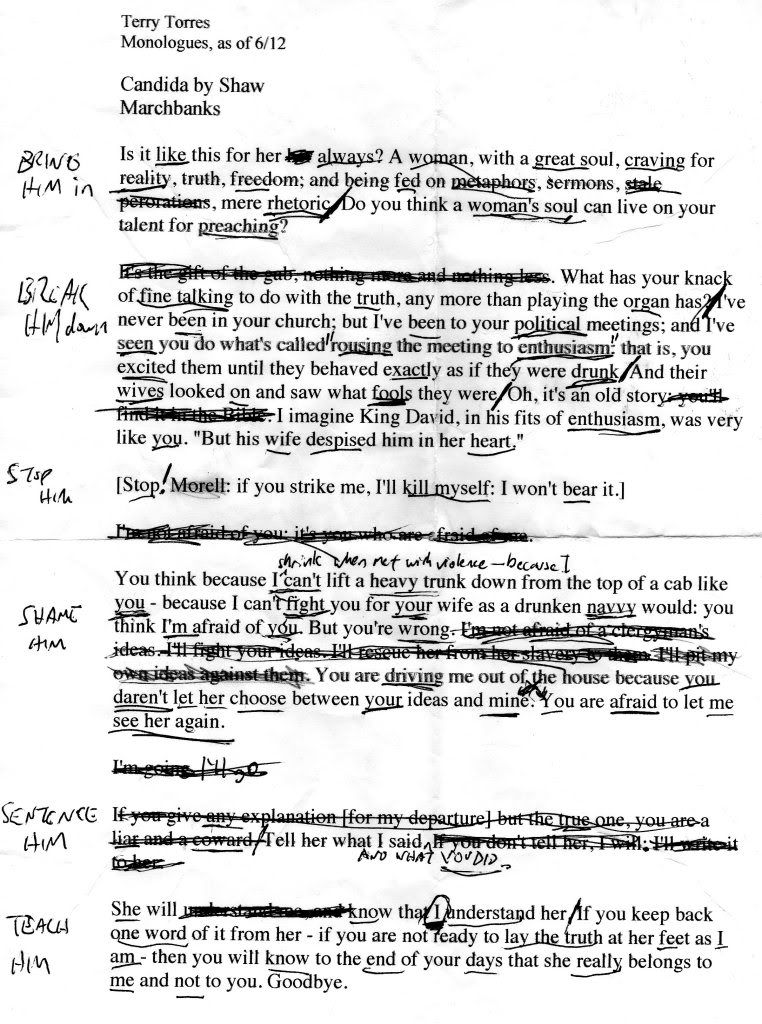
I used to write out monologues by hand, but I typed this one because I had to do some serious editing with it.

This one's from George Bernard Shaw's Candida. It's not commonly known from my understanding, but it was part of a Shaw collection I'd bought a long time ago. I happen to like it quite a bit. The character of Marchbanks here is professing his love to the wife of a preacher and political leader, telling him that he is unfit of his wife's love.

HOWEVER! Most of this monologue is actually from quite a bit of dialogue between Marchbanks and the preacher. Most of the line breaks represent dialogue that was cut. Thanks to Shaw's writing, Marchbanks' point still makes sense with the cuts.

There are a lot more words crossed out. That's mostly for the sake of timing - this should run at about 2 minutes. I cut anything that didn't support that main point of the monologue.

And then, y'know, I underlined some lines. This is mostly placebo-esque voodoo nonsense, but I pick the words in a sentence that are most important. It might seem really obvious, but going through the monologue underlining words that strike you as you speak them aloud, I think, is just another way to bring you and the text closer together. And really, that's what this is all about.

/'s help me indicate beats shifts, where my objective changes.

The big shift in this monologue is right in the middle: "Stop! Morell: if you strike me, I'll kill myself: I won't bear it."

This is a direct reaction to something that the person being spoken to does physically to the speaker - something that doesn't actually happen. It's a tough sell, but the beauty of this monologue is what changes in Marchbanks before and after this altercation - how self-assured he starts, and how incensed he becomes. I've never done anything like this before in a monologue, but I think it works.

I'm also told this, being written by Shaw, is what we would call a modern monologue, as opposed to a classical or contemporary monologue. From the way I understand it,

Classical: Like Shakespeare and those guys.
Contemporary: You could talk to the child of this writer, or the person if they are still alive.
Modern: Whatever isn't the first two (The writer has been dead for a while, but not like SUPER long).

Once it's all written, I just go through it, taking each phrase off the page. That is, whenever I say the words aloud, I never look at the words on the page - I always looks elsewhere. Otherwise, the words will just stay on the page. If you take them OFF the page, they'll float into the air and then into your brain. Seriously, try it.

Once I've got it memorized (and this is the hard part), I go through the monologue and as I speak each word I perform a gesture to go along with it. Like, everyone word, even "the". You don't have to think TOO hard about each gesture, you just have to make sure that each one is different from the last. For a two minute monologue, it might take 10 minutes or so. But it's worth it. I'm told this is one of those Meisner techniques? Whoever THAT guy is! Anyway, it helps me figure out how I REALLY feel about the text.

After that, I go through again, instead I perform it with my arms at my side, looking straight ahead, super-minimalist. Kinda like a "cool-down" from the previous exercise. It also helps me figure out which times I'm driven to move my body, when I'm real excited and I just wanna DO something.

After that, I do whatever. Might go through at half volume as I walk about town. I might do it again in a public place, like a hill in Boston Common, where people will think it's funny.

And hey, dudes: do your monologue for at least one other human being before your audition. You may not be crazy into the idea, but it almost always gives you useful insight. Well, as long as you know insightful people. Anyway, you won't truly know how a monologue works in front of people until you do it in front of people.

EDIT (6/21):

Something I just realized is that all of this editing of an existing work, you might think, "Well, why not just write your own monologue?"

The thing about writing your own monologue is don't write your own monologue. Editing is one thing, because you can still say of this monologue, "It is from George Bernard Shaw's Candida."

However, if you were to introduce your monologue in an audition by saying, "This is a monologue I wrote," you're conveying that you could not find an existing monologue that you could make work, so you wrote one for yourself.

Acting is interpretation. In an audition, a director is asking of you, "How well can you interpret text, and how well will you be able to interpret my direction?" By doing a monologue you have written, you're saying, "Nope, I can't do any of that shit! I'll just audition with this thing I already know all of the subtext for because I wrote it."

So, yeah. I don't think that's actually a thing too often, but don't do it.

Friday, May 25, 2012

#1. Titanic Theatre Company

I was a in Family (de)Values with Marc Harpin. He also played the Loving God in Theatre on Fire's Almost an Evening.

He invited me to audition for the part of Zygote in The Third Story, produced by Titanic Theatre Company. Zygote is described as being "grotesque, yet eerily beautiful". I think that describes me pretty well, and I considered it a compliment to be invited.

I was real happy to audition, especially because I realized that if I didn't get into something before Romeo and Juliet went up, the latest three entries on my acting resume will all be Brown Box Theatre Project productions. That's not the worst thing in the world, but I don't want people getting the wrong idea that I haven't been up to all sorts of other activities as well.

The side I was provided is a pretty great self-contained scene in which Zygote, a science experiment, confronts his creator. I actually came at it pretty seriously. I didn't research The Third Story too much, else I would've found out it's something like a gangster sci-fi B-movie, and I would've had more fun with it.

The audition was held at Marc's pad in Chestnut Hill. Chris Wagner was there when I came in. He was also trying out for Zygote. And he's a comedic genius. So I was a little anxious, but I tried not to sweat it.

While he auditioned before me, I looked over the information on my audition form. The rehearsal schedule was basically already set up for all of July and the first half of August. BUT. I wasn't sure if it would conflict with Romeo and Juliet. I knew they were both around the same time, but I'm playing Paris, so maybe it's not a big deal?

I had already come all this way. I was invited, and I'm in so few shows a year. I was kinda wearing rose-tinted glasses, seeing opportunity where there was none. We could see if this works!

I could hear that Chris was going big and funny with his audition, so I tried to keep it reserved and a little sad, hoping that would be funny, too. I actually tried to memorize a lot of it, and it turns out that it's tough to be in between memorized and not memorized at all. The director seemed to think it was painful watching me search for lines, and let me know that I could use the side I'd printed out.

He asked me what Zygote wanted from the doctor that created him in this scene. I said: "To admit that she's wrong." He said, though, Zygote wanted her love.

He let me have another go, and then we talked about callbacks. Could I come Wednesday night? As long as its before rehearsal for my play about a toaster who wanted his non-driver photo identification! They liked that.

So after I reviewed things, I found out I basically had no hope of being in the show without breaching my Romeo and Juliet contract. It pained me to mail Marc back telling him I wouldn't be showing up to callbacks. Break legs, Titanic Theatre Company! Also, you have a nice website.

Things always get so active in the theatre around this time of year. I'd love to get more audition offers during winter.


9 headshots remain.

Also! I got a new headshot. Check it out.

Oh, yeah, I'm in Romeo and Juliet.


Yeah, it's gonna be great. I'm Paris. I ain't in a LOT of scenes, I don't have a LOAD of lines, but I get to fight Romeo and die in the last scene. And I get to tour in Maryland. So! I'm down with that.

Wednesday, March 7, 2012

The Starving Actor: Carbonara

Welcome to the first installment of The Starving Actor, with which I hope to help starving actors feed themselves.

Starving actors starve for many reasons. Mostly it's because they're poor. Sometimes they don't have time to feed themselves. Some just don't know how.

Starving actors deserve to eat well, and they don't need to lose their money or their self-respect. And they don't need fennel bulbs or agave syrup or two kinds of paprika to do it.

Our inaugural recipe, carbonara, might be on the pricier side for the most starving artists, but if you're smart and/or lucky, you can find all the ingredients you need on sale or in cheaper forms.


This recipe, originally based on one created by self-proclaimed King of Carbonara Tom Cruise, is the result of many years of experimentation and refining. That said, you'll find I don't often worry myself with the specifics when it comes to step-by-step instructions, and often deviation can result in something wonderful.

Carbonara

Half a package of bacon (about 1/2 pound)
A medium-to-large-sized onion
Half a package of linguini (about 1/2 pound)
2 large eggs
1 cup of Parmesan cheese
Some olive oil
Some salt
Some garlic powder


1. Chop the bacon and onion. Keep each piece of bacon lined up, just like they are in the package, and cut them into little strips, like matchsticks. We find that thick-cut bacon works best, as it does in all situations. Stop and Shop had a ridiculous sale; two packages of bacon for the price of one. Classic Italian versions of this recipe call for pancetta or a similar classical ham. Oscar-Meyer works great for us.

The onion should be chopped pretty finely to match the size of the bacon. The goal here is to try and reach a 1:1 ratio of bacon to onion. Our five strips of thick-cut bacon are just slightly outnumbered by the large onion we had, but that's okay. As long as we're close.


2. Set a pot of water to boil for your pasta. By the time you're done with the next few steps, it should be ready and boiling.


3. Cook your bacon over medium heat in a large-ish pan. Unlike some meats, bacon is fatty enough to cook fine on it's own without oil or butter or anything, but we put in a little dollop of olive oil to keep it from sticking to this particular white ceramic pan we're using. Spread the bacon out evenly and let it sit for about 4~5 minutes, stirring occasionally to make sure it's not browning too quickly.

The goal here is not to get the bacon crispy, as you may like it with your eggs in the morning, but tender. As you stir your bacon, you'll see how it goes from being raw and mushy to being tender - less flexible when moved, but still soft.


You can also tell your bacon is ready once it's swimming in its own simmering fat. Don't be afraid of the pink color - I guarantee at this point they're cooked through. Feel free to taste-test a piece and see if it's to your liking.


4. Set the bacon aside. Use your spoon or paddle or spatula or whatever you've chosen to place it on a plate with paper towels, so it's not sitting in its own grease.

Now some more adventurous chefs will be tempted to keep the bacon grease in their pan to cook the onion, as to impart that bacony flavor. In the past, it has resulted in the onions becoming extremely dry and weird, but if you're careful and stay attentive, it may be worthwhile. Otherwise you can take your pan and dump it into your sink, OR, if your landlord has told you not to do that, pour it into a glass, and then pour it into your garbage when it's cooled some.

OR, you could even reserve the grease in a jar or some other container and use it to cook something else, the same way you'd use olive oil or butter. It's great for frying eggs!


5. Cook the onion in olive oil, just enough to coat them. Stir 'em a bit to make sure they're all shiny and coated in oil, so they cook evenly. Let them sit for two minutes, then add a dash of salt and, like, half a dash of garlic powder. Give them another stir, then drop the heat a little bit and leave them alone until they get a little softer.


5. Cook the pasta, according to the instructions on its package, preferably until it's just gotten al dente. We used linguini. We just think it works better in the recipe because it's broader than spaghetti. Feel free to try thick spaghetti or something like that if you have it. At your own risk, of course.

While your onion and pasta are cooking, now may be a good time to grate your Parmesan cheese so that it's ready. "Grate my cheese?" you say, "What do I look like, a chump?" If you're paying for pre-grated cheese, then Yes you are! Not for snooty culinary reasons, but because buying your cheese in block form will save you money! Just compare the unit prices and you'll see. If you've already gotten grated cheese or don't OWN a cheese grater, I won't judge you.

In another time and place I'd advise against those Kraft powdered Parmesan cheese tubes, but this is The Starving Actor, so go with what you've got.


6. Check on your onions. Give them a stir and take a look at them. Once you see some pieces that are just turning translucent, turn the heat off and add the bacon back to the pan. Give it a stir.


7. Drain your pasta, and put it into a bowl. BUT BEFORE YOU DO, pour a tiny splash of hot pasta water into the pan with the bacon and onion. It may seem like a weird thing to do, but it provides a certain consistency among the ingredients.


8. Add the bacon and onion to the pasta and mix it up till it's more or less spread throughout. Most of it will gravitate toward the bottom, which is totally normal.

At this point, let everything sit for a minute to cool. Then mix it again.


9. Add the two eggs to the pasta and mix it up again. That's right, guys: raw eggs. If you've never heard of carbonara before, you might be thinking, "Pink bacon, raw eggs, is this guy trying to get me killed?!" Don't even worry. Believe it or not, as the eggs coat everything, the warmth from the pasta will cook them.

Early in my cooking career, I'd end up with tiny pieces of scrambled eggs clinging to my pasta, because the pasta was too hot and the eggs would cook too soon for too long. I've worked several steps into the recipe to resist this possibility, like combining everything in a separate bowl (I used to just dump it all back into the pot I used to cook the pasta) and letting it sit for a minute.


10. Add the cheese then mix that all up. The egg will combine with the cheese and a creamy sauce will come into existence.


And you got yourself some Carbonara! Serve with some crusty bread or some salad, or, y'know, by itself.

PROTIP: If you want to reheat leftovers, make sure to have it covered by something so it doesn't dry out. Like, if you've put it in some Tupperware, keep the lid on at an angle. Some say it tastes even better the next day!

Sunday, March 4, 2012

Dealing with acquaintances post-show


How do you deal with awkward encounters with acquaintances after your show? More, less misanthropic suggestions are certainly welcome.